As a Biostatistician, I am fortunate to work on super interesting scientific challenges - I have the privilege to work with experts looking to answer novel research questions, and work across Early Phase Clinical Trials, Trial Design Consulting and Regulatory Statistics. Being at a CRO that really focuses on collaboration and partnership with sponsors is one of my favourite aspects of the job.
What I don’t get to do through the course of my day job is develop my own research from scratch. I have a keen interests in sports, gaming and (through my early career work in Biomarkers) molecular biology - I love digging into things & seeing what I can get out of data.
For the last year, I have been using both Claude Code and OpenAI’s Codex CLI (Command Line Interface) for Agentic Coding on various side projects, and it has been quite honestly mind-blowing in terms of what avenues have opened up to power my own research. It’s a whole different ballgame. I’ve also started exploring local and offline models, and getting to understand a little better the architecture of LLMs and how they work. I of course don’t claim to be a Machine Learning Developer or AI Engineer, Biostatistician fits me just nicely for now.
What is a coding agent? (my understanding as a Statistician)
A coding agent is a LLM within a harness (a software program) that can write, test and validate code for you, where you give it the goal, spec or idea in your own words via prompts. The agent can use tools (e.g. web search), run code and check outputs. Honestly, even just writing that is not doing it justice - the capabilities are kind of mindblowing.
Coding help to coding hand-off
Ideas, questions and concepts where I believe I can bring a unique biostatistical or domain insight, but am hamstrung in technical implementation (SAS and R can only get you so far!) or by the sheer effort needed to build the programmatic support around the main statistical models - these are suddenly achievable. For example, in order of a little coding help to completely coded by AI:
- What are the design options for a study that optimizes cut-offs of two predictive biomarkers in a Ph2 oncology study?
- Can I predict injury risk based on multi-disciplinary training load and daily health statistics?
- Given enough data, can I create an offline bot that mimics human behaviour in a first-person shooter?
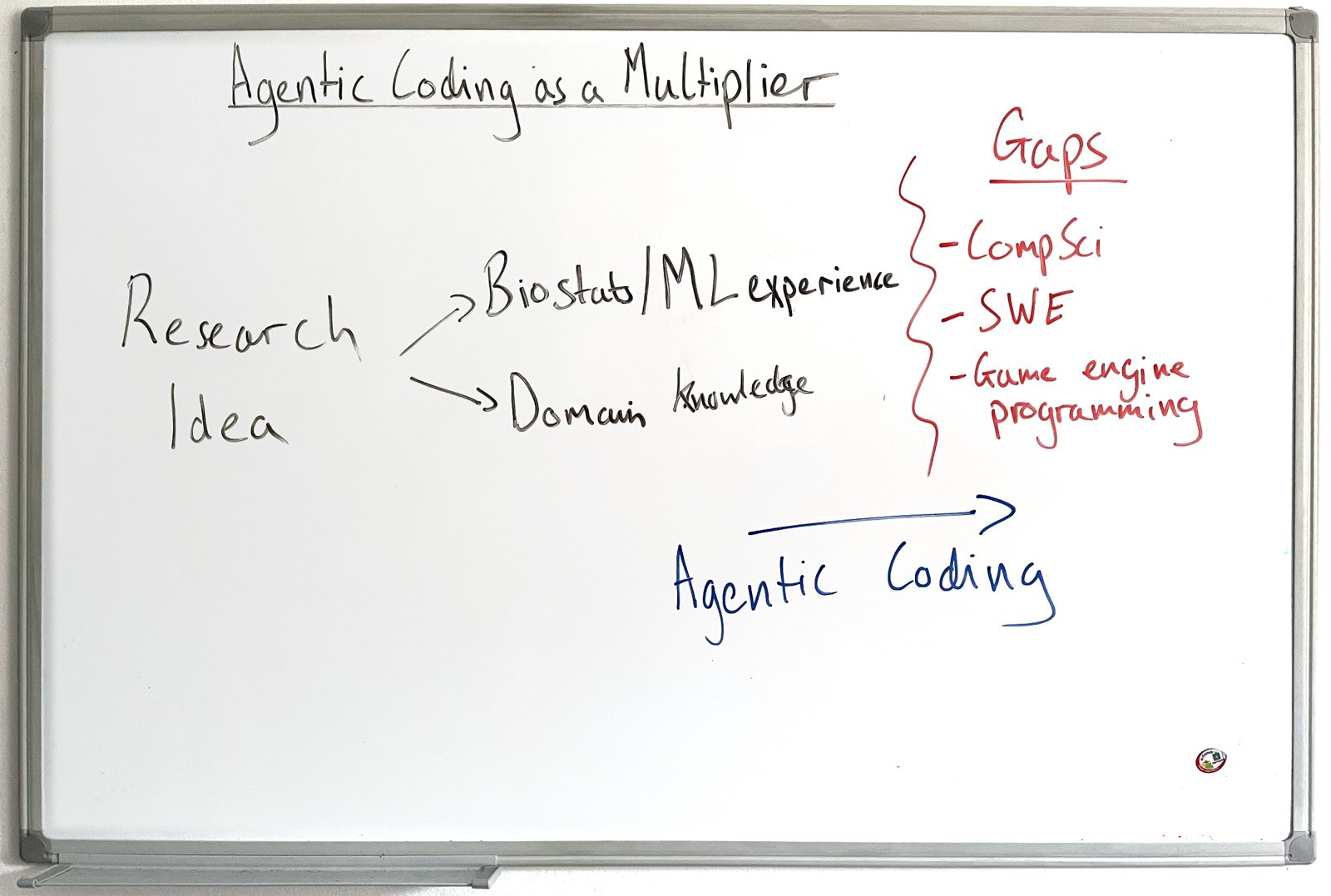
Some of these I could already tackle - Ph2 study design is directly within my wheelhouse and is something I have implemented in R. Using Claude Code to review and optimize my R workflow was quite neat, and I could give it very focused tasks and fully read the inputs/outputs. As people say - it raised the level of abstraction one step; no need to write R code (although I still did write a chunk of the code the old way - particularly model statements & ensured the rstan code looked correct).
Sports injury risk is one I can partially tackle - I have access to my own Garmin and Strava data. From the stats side, this is entirely me - the statistical risk model I have created in R, but the blocker is creating an end-to-end pipline that pulls directly from the relevant APIs.
On my own this would be a substantial side project just to learn the programming language (python) needed, and understand how to pull form Strava’s API - but with a coding agent, I can give it a clear spec and directions, and it created & validated the data pull for me.
Easy enough for me to check, and still very understandable. I don’t need to understand or know python, I can give the agent higher level abstractions of what I want - e.g. “I want to pull these fields from the API in a format that can feed into my model written in R, check Strava’s API documentation & implement the correct rate limit. I want to pull all historical activities, and with new pulls I want to include only new activies. Output what other fields are available from the API so I can decide if I need those too”.
As an enabler of more complex ideas - helping me build a bot
Others were completely out of reach from a practical standpoint - for example, I want to play around with creating an offline bot for a video game that mimics human behavior. This is directly adjacent to my Biostatistics experience - model selection, training, validation are all something I am comfortable with. Although I do have to swap my vocabulary to more Data Science-y/ML speak and talk about features, loss etc.
But how do I get my make my model control the bot - how do I link it to a game and make it drive a character? Where do I get and process the raw data from? Where do I even start - do I need to learn C++ or Python? What about understanding the game engine? R is useful for model fitting and training, not so useful for controlling a bot in Counter-Strike.
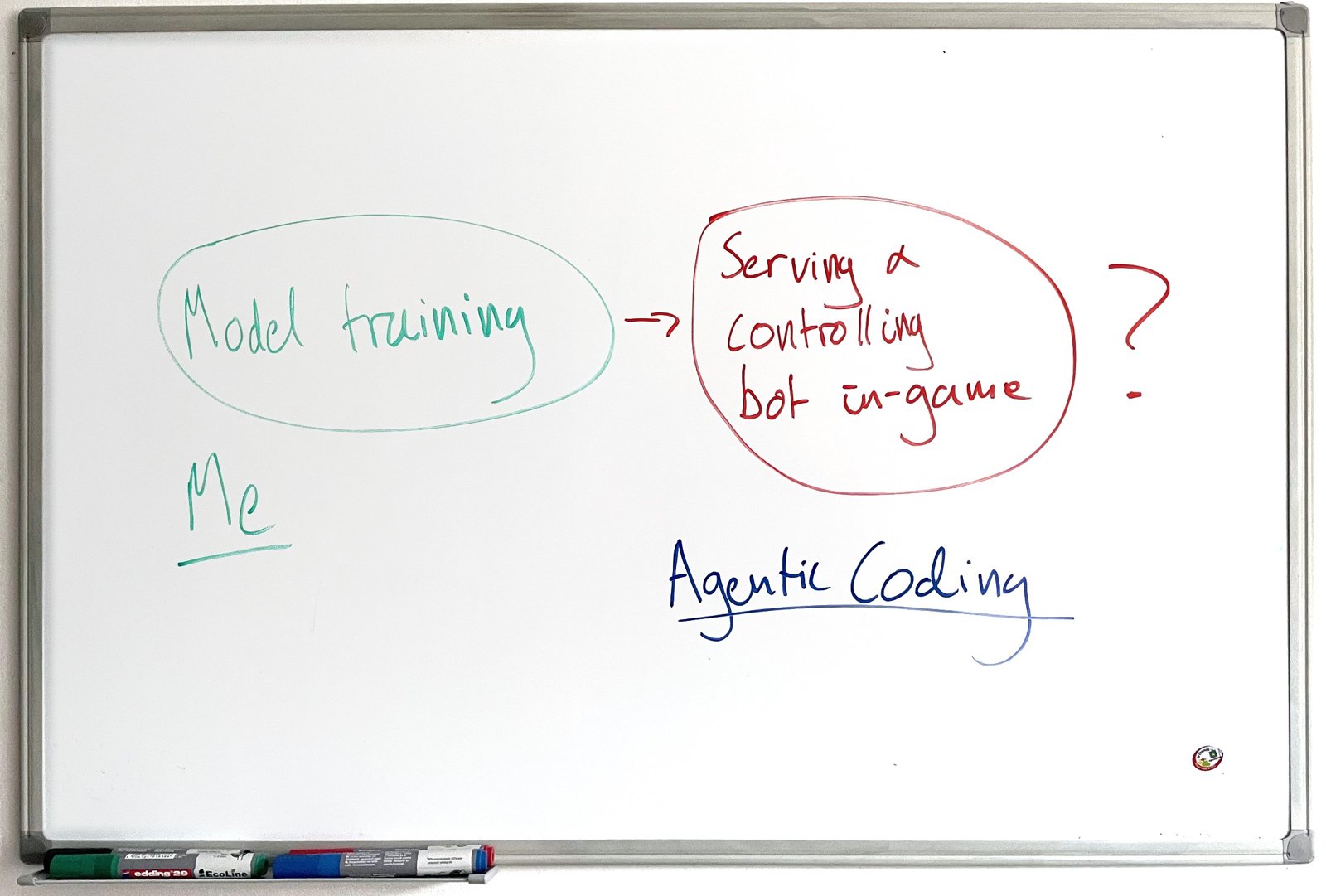
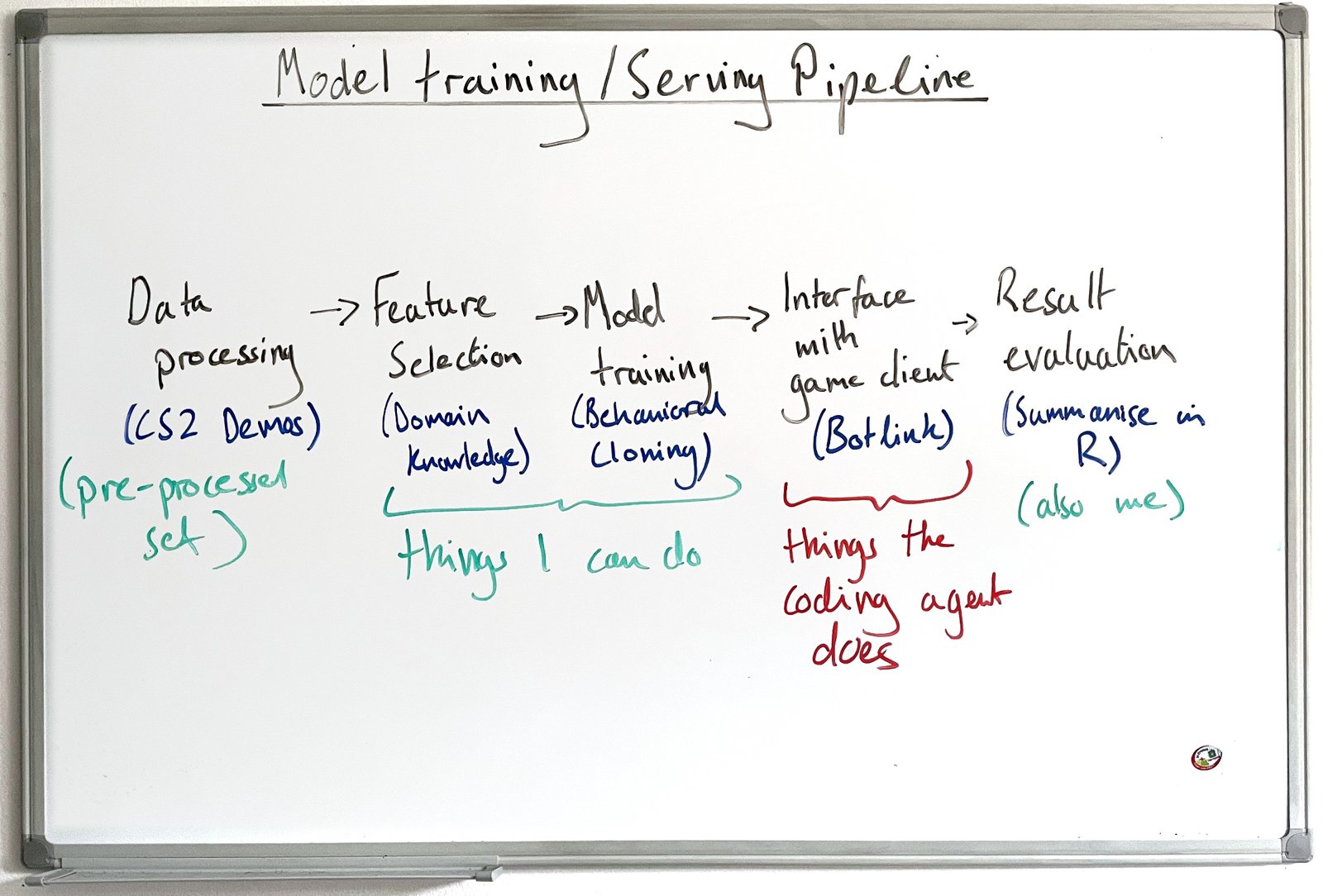
Here, I can give my high level goals to the coding agent and let it tackle the interface - here is where I lose the understanding of the actual code written (I don’t know C++, and I can just about follow along reading basic Python scripts). But I can check the results, I can describe evaluation tests for the coding agent to implement and work on the statistical and scientific thinking.
My advice for 2026
My advice to Biostatisticians and Programmers in 2026 - Forget what you learned about AI chat in 2024 and 2025. Forget prompts that start with “You are an expert Biostatistician and….”. Forget about em dashes. Start learning how to orchestrate coding agents. Start learning the high level difference between a harness, agent and a model. Start playing around and seeing what you can create.
Upcoming Topics
- Getting started - Claude Code and OpenAI Codex
- Local LLMs - Offline Model Inference & Hybrid “Frontier in the Loop” Inference
- How I am using cloud models to develop my ideas; behavioural cloning, DAgger
- Autonomous research loops
Links & Getting Started
Things to check out - I use the paid plan on both Claude Code and OpenAI Codex.
Claude Code
- Claude Code quickstart
- Claude Remote Control - using the app on your phone to run work on your computer.
OpenAI Codex
Git & GitHub
Some links below, but hostly you can use ChatGPT or Claude for a rundown and quickstart guide tailored to your setup/domain area. You can even just use the CLI to configure it all for your locally.
- GitHub Hello World - getting started guide
- Introduction to GitHub - interactive GitHub Skills course
- Happy Git and GitHub for the useR - git & GitHub from an R user’s perspective (this was super useful last year when I started with Git in R)